 bg
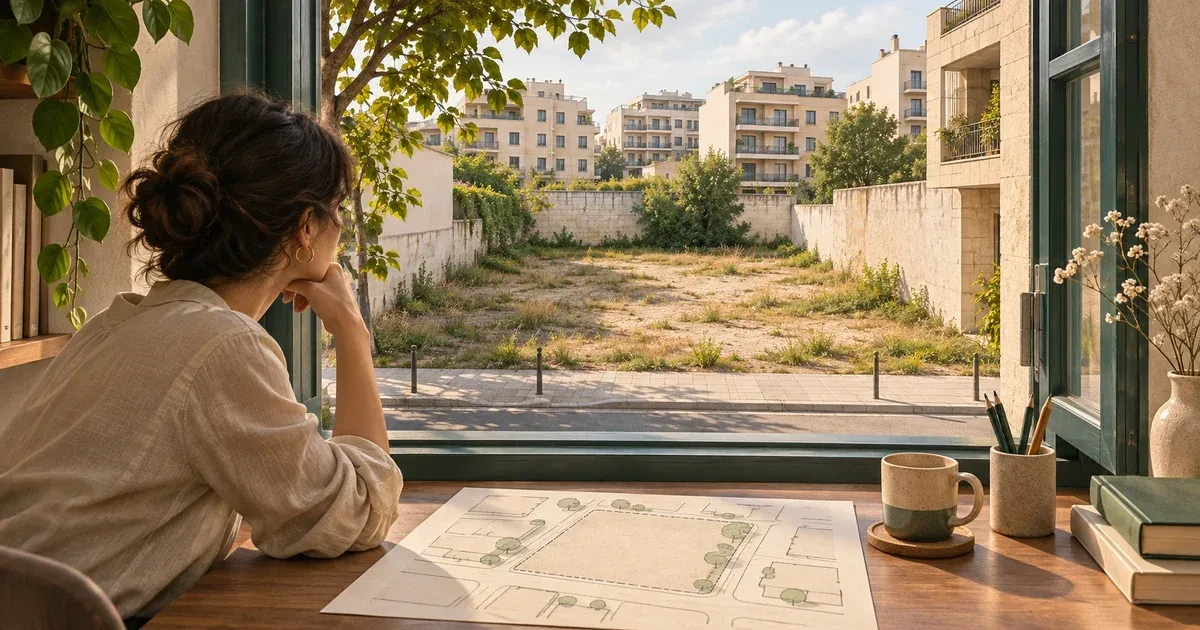
AI-generated illustration. Not a real development, map, client or transaction.
To investigate what could be built in front of an apartment in Bulgaria, first identify the exact neighbouring land parcel. Then check the relevant planning documents and available building permits. An empty plot, greenery in an architectural visualisation or an unsuccessful online search does not guarantee that the view will remain unchanged.
This is particularly useful when daylight, privacy or open space is the reason you prefer one apartment over another. You do not need to become a planning specialist. You do need to know which parcel is being discussed and which document supports the answer you receive.
Start with the right parcel
“The empty space beside the building” is not a precise enough description for a records search. It could include several land parcels, and a fence on site may not reflect the boundaries shown in the documents. Ask the seller for a site plan identifying the building and surrounding plots. Mark the direction your apartment's windows face, rather than looking only at the entrance location.
The starting reference is the neighbouring land parcel's cadastral identifier. This is its unique number in Bulgaria's cadastral system. Do not substitute the identifier of the apartment you intend to buy. The Agency for Geodesy, Cartography and Cadastre explains the identifier on its official website.
Use the KAIS cadastral map to establish the location. If different documents show different numbers, ask a surveyor or the municipality to clarify the match. Selecting a nearby parcel that looks approximately right can lead to an answer about entirely the wrong piece of land.
A map, a development plan and a permit answer different questions
The cadastral map identifies properties and their boundaries. It does not promise a future view. The agency's explanation of cadastral information describes what those records contain.
A general development plan provides the broader planning framework. A detailed development plan, usually abbreviated as PUP in Bulgarian, deals with a defined area in more detail. A building permit is a separate act concerning a particular construction project. These documents are not interchangeable. Bulgaria's Spatial Development Act provides the underlying framework.
For a purchase decision, the status of a document matters as much as its existence. A proposed amendment is not the same as a change already in effect. Read a published decision with its attachments and relevant information about its effective status. If that remains unclear, ask the responsible authority or a qualified specialist before treating the matter as settled.
Starting the check in Sofia
Sofia Municipality's official building-permit register includes search fields for cadastral identifier, address, regulated plot, district and status. You can therefore begin with the land parcel rather than a development's marketing name.
Enter the identifier you have obtained. If a record appears, compare its address and description with the plot in front of your chosen apartment. Note the act's number, date and issuing authority, then inspect the available details and linked documents. The register also directs users to orders associated with individual permits.
If nothing appears, check the number and try the address. If there is a mismatch or an unresolved question, contact the relevant district administration or municipal planning department. Include the identifier and a map marking the parcel. Asking whether that particular plot has an effective detailed plan, amendment proceedings and an issued building permit is more useful than asking whether somebody might build “nearby”.
Starting the check in Burgas
The Burgas municipal map provides an address or property search and separate cadastral and planning sections. Locate the address, orient yourself using the surrounding streets and match the land with the identifier under investigation. Examine the available planning information for the same location.
The Municipal Council's approved detailed development plans section is another starting point. It publishes decisions on particular plans, but should not be treated as an exhaustive record of every act and procedure affecting every parcel in the municipality. Read the relevant description and attachments, not only the headline.
If you can see a planning zone but cannot locate the documents for the neighbouring plot, do not infer an allowed number of storeys from a map colour. Ask the municipality about the applicable plan and available construction records. An architect can relate those documents to the position of the apartment you are considering.
Turning the findings into a buying decision
Imagine two apartments in the same building. One faces undeveloped land with an open view; the other faces an established street. This is a hypothetical example, not a description of a particular development. If the first apartment overlooks land where development is contemplated, today's photographs are not enough for a meaningful comparison.
Ask an architect to examine the possible building position, heights and separation in relation to your windows. Assessing potential shading requires specific geometric information. “South-facing” alone does not answer the question. Separately, consider whether a possible construction period next door would affect your willingness to buy.
Keep a dated record of the check. A useful conclusion is not simply “nothing will be built”. It is a statement of which parcel was examined, which documents were found and which questions remain unresolved. That gives you something concrete to discuss before paying a deposit without creating false certainty.
When exploring TV Property's projects, ask to see the individual apartment on both its floor plan and the site plan. Discussions about daylight and outlook can then start with the home's actual position rather than the visualisation alone. For a final assessment of a third party's neighbouring plot, obtain independent technical advice and legal advice where necessary.
Sources and the referenced public interfaces were checked on 5 November 2026. This is general practical guidance, not an assessment of a particular property. Most linked municipal and legal sources are in Bulgarian.
Frequently asked questions
No. The land's present appearance does not establish what might be permitted there. Identify the parcel and check the applicable plans and available construction acts.
No. An inaccurate identifier, a different description or the need for a further administrative enquiry may explain a missing result. An unsuccessful search is also not a guarantee about the parcel's future development.
No. It helps identify the property. Questions about future construction also require the relevant planning and building documents.
An architect can assess the technical implications using the relevant documents and the apartment's actual position. Consult a lawyer as well if property rights or the status of an administrative act are in dispute.

Vladimir Kolev is the CEO of TV Property and an entrepreneur in the field of residential and investment properties. He graduated in Economics and Mathematics from the University of Bath and Sofia University and has practical experience in the development of distinguished residential projects in Sofia and along the Black Sea coast.